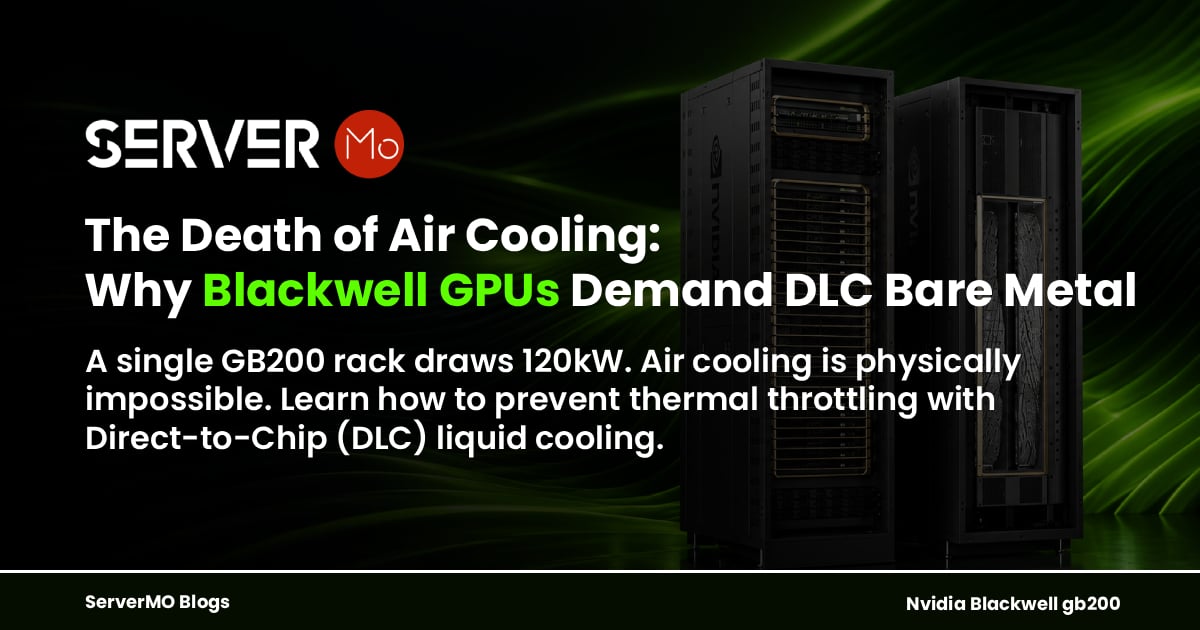
The Death of Air Cooling: Why NVIDIA Blackwell GPUs Demand DLC Bare Metal
Air cooling is dead. Master the 120kW rack math, OAT coolant chemistry, and direct-to-chip liquid cooling for NVIDIA Blackwell GPUs.
The release of the NVIDIA Blackwell architecture has fundamentally ended the era of the air-cooled data center. As organizations push to train trillion-parameter models, the search volume for data center liquid cooling has skyrocketed. This is driven by one harsh engineering reality: you cannot run next-generation AI hardware on legacy infrastructure.
When an enterprise investigates NVIDIA Blackwell GB200 deployment specifications, they are met with a staggering number: 120kW per rack. Traditional server racks operate between 8kW and 25kW. Attempting to cool a 120kW AI cluster using massive AC fans is a physical impossibility that results in violent thermal throttling, reduced token generation, and degraded hardware lifespans.
In this Datacenter Engineering deep-dive, we break down the mathematical limits of air cooling, explore rigid chemical specifications required for Direct-to-Chip (DLC) cooling, and reveal why elite SREs are abandoning shared Cloud VMs for dedicated Bare Metal.
Phase 1: The 120kW Rack Reality & Heat Flux Limits
The transition from the NVIDIA H100 (700W) to the Blackwell B200 (1,000W to 1,200W) is not an incremental jump—it is a categorical shift in physics. The GB200 Grace Blackwell Superchip pairs one Grace CPU with two B200 GPUs, connected via NVLink-C2C at 900 GB/s, pushing a combined module TDP of nearly 2,700W.
The Air Cooling Impossibility
The GB200's heat flux reaches an unprecedented 500–600 W/cm² at the die interface—similar to nuclear reactor fuel rods.
A full GB200 NVL72 rack (integrating 72 GPUs and 36 CPUs) draws roughly 120,000W to 132,000W. Removing 120kW from a single 21U enclosure via forced air would require ~85,000 CFM of airflow. That velocity produces acoustic levels exceeding 90dB and structural loading that destroys chassis integrity.
The Engineering Solution: Direct-to-Chip (DLC) Liquid Cooling. By mounting vacuum-brazed copper cold plates directly to the silicon, DLC systems achieve a thermal resistance of ≤0.03 °C/W using a dedicated Coolant Distribution Unit (CDU).
Phase 2: Coolant Chemistry & Galvanic Corrosion
When moving to high-density setups, treating liquid cooling like standard plumbing is a catastrophic mistake. The cold plates attached to the GPUs are constructed from C1100/C1020 copper, which interacts violently with aluminum structures if the fluid is impure.
- The Conductivity Standard: Coolant electrical conductivity must be strictly maintained between 5 and 10 µS/cm. Higher spikes accelerate galvanic currents and corrosion.
- The Particulate Limit: Microchannels inside the cold plates are machined to 200–300 µm. Coolant must be filtered below 50 µm to prevent immediate flow restriction and thermal hotspots directly above the GPU die.
- OAT Inhibitors: You cannot use conventional silicate-based (IAT) coolants. Elite facilities utilize OAT (Organic Acid Technology) inhibitors. Because the boundary-layer temperature reaches 60°C under heavy AI training loads, OAT inhibitors degrade 2x to 3x faster. Reserve Alkalinity must be monitored quarterly; if it drops below 65%, copper plates will begin to pit within 90 days.
Phase 3: Physical Limits of Legacy Facilities
Many IT leaders assume they can simply retrofit their existing air-cooled data centers. The retrofit math is unforgiving. Rear-door heat exchangers only scale up to 40–70 kW. They mathematically cannot support a 120kW NVL72 deployment.
The 3,000-Pound Floor Crusher
A fully populated liquid-cooled GB200 rack weighs 1.36 metric tons (approx. 3,000 lbs). Over 68% of enterprise data centers built before 2015 feature "Raised Floors" designed for 15kW racks. These floors will literally collapse under the Blackwell point load. Slab-on-grade concrete flooring is required.
Additionally, delivering 120kW+ without melting cables requires multiple high-amperage 415V/480V 100A three-phase whips. Standard 208V PDU plants are categorically undersized for this electrical load.
Phase 4: Escaping Cloud Throttling on Bare Metal
Why are SREs desperately searching for Bare Metal instead of renting hyperscaler instances on AWS or Azure? The answer lies in the "Shadow Index" of cloud computing: Noisy Neighbors and Thermal Throttling.
When you rent a shared Cloud VM, you share the facility's underlying cooling loop. If the rack exceeds its thermal ceiling—which happens frequently with 1,000W GPUs—the GPU's internal RAS (Reliability, Availability, and Serviceability) engine automatically lowers the clock speeds to prevent hardware burnout.
You pay full price per hour, but this silent thermal throttling extends your LLM training times by 15-25%.
| Infrastructure Type | Cooling Reality | Compute Performance | Egress Fees |
|---|---|---|---|
| Shared Cloud VMs | Shared facility loops | High risk of thermal throttling | Exorbitant |
| Retrofit Data Centers | Fails above 40-70kW | Hardware degradation risk | N/A |
| ServerMO Bare Metal | 100% Isolated Dual-Loop | Maximum sustained FP4/FP8 | $0 |
By migrating to ServerMO GPU Dedicated Servers, you secure a 100% isolated, purpose-built liquid-cooling environment. You eliminate thermal throttling, ensure maximum FP4/FP8 compute performance, and bypass astronomical Cloud Egress taxes associated with moving terabytes of training data.
👉 Rent the raw power, not a compromised, thermally-throttled cloud slice. Read the full deployment guide on ServerMO:
The Death of Air Cooling: Why Blackwell GPUs Demand DLC Bare Metal | ServerMO